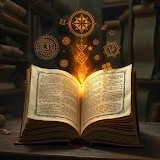

Norse Mythology: Gods, Runes and the End of the World
Discover Norse mythology: the nine worlds and Yggdrasil, gods like Odin, Thor and Loki, the runes, and the inevitable Ragnarök.

Imagine a town where yellow butterflies rain down for months, where a woman ascends to heaven while hanging the white laundry, or where the dead converse with the living without anyone batting an eye. We’re not talking about pure fantasy or fairy tales here, but about magical realism, that extraordinary literary movement that redefined the boundaries between the real and the imaginary, turning Latin America into the epicenter of a narrative revolution that conquered the entire world.
Magical realism isn’t simply a literary technique or a stylistic device: it’s a worldview, a particular way of understanding and narrating reality that emerges from the depths of cultures where the mythical and the everyday have always walked hand in hand. It’s the literature that taught us that magic isn’t separate from life, but woven into every corner of our existence.
The history of magical realism begins far from the tropical jungles and dusty towns of Latin America. Curiously, the term was coined in 1925 by the German art critic Franz Roh, who used it to describe a post-expressionist pictorial movement that presented everyday reality with a strange precision that revealed unusual and mysterious aspects of the ordinary. Roh sought to name those paintings that, without resorting to explicit fantastic elements, conveyed a sense of unreality through the meticulous depiction of the visible world.
This concept, originally pictorial, crossed the Atlantic and found in Latin America fertile ground where it would take much deeper root. It was the Venezuelan writer Arturo Uslar Pietri who, in 1948, moved the term into the literary sphere, identifying in Latin American narrative a tendency to consider “man as a mystery among the realistic data that surround him.” However, it would be the Cuban Alejo Carpentier who would make the definitive conceptual leap.
Carpentier preferred to speak of “the marvelous real of the Americas,” arguing that Latin American reality was intrinsically extraordinary, that it needed no invention because the marvelous was present in the history, geography, and idiosyncrasy of the continent. In his famous prologue to “The Kingdom of This World” (1949), Carpentier maintained that the marvelous began to be so unequivocally when it arose from an unexpected alteration of reality, a privileged revelation, an unusual illumination of the unnoticed riches of reality.
This distinction is no small matter: while European surrealism sought the marvelous through artificial provocation, Carpentier argued that in Latin America the extraordinary was a constitutive part of the real. The Amazon rainforest, indigenous cultures with their complex cosmogonies, the violent history of conquests and revolutions, religious syncretism: all of it constituted a reality that was already, in itself, magical.
To truly understand magical realism, we must look beyond academic definitions and immerse ourselves in the cultural substrate that made it possible. Latin America is a continent where multiple temporalities coexist, where indigenous worldviews were not completely eradicated by colonization but merged with European Christianity and the African traditions brought by the enslaved, creating a unique syncretism.
In Latin American rural communities, beliefs in spirits, apparitions, and unexplained phenomena are not marginal superstitions but an integral part of lived experience. A peasant can speak casually of a goblin that stole his tools, a grandmother can warn about the evil eye without irony, and no one questions that dreams can be premonitory. This multilayered reality, where the empirical and the mythical coexist without contradiction, is the breeding ground of magical realism.
The writers of magical realism didn’t invent this perspective; rather, they captured it in literary form. They were cultural translators who found a way to convey in words an experience of the world that had always been there, but that traditional Western literature, with its Cartesian rationalism, had been incapable of expressing.
Oral tradition played a fundamental role in this process. Many magical realist authors grew up listening to stories told by grandmothers, nursemaids, or inhabitants of towns where legends were narrated as if they were journalistic chronicles. This oral tradition, where the fantastic is recounted with the same naturalness as everyday events, became the characteristic narrative tone of the movement: the voice that tells of prodigies without astonishment, that accepts the impossible as part of the natural order of things.
Although magical realism as a concept and literary practice had been brewing since the forties, it was during the so-called “Latin American Boom” of the sixties and seventies that it reached its fullest expression and worldwide projection. This publishing and cultural phenomenon placed Latin American literature at the center of the global stage, and magical realism was its most dazzling calling card.
The publication of Gabriel García Márquez’s “One Hundred Years of Solitude” in 1967 marked a before and after. This monumental work, which narrates the saga of the Buendía family in the mythical town of Macondo, became the paradigm of magical realism and one of the greatest publishing successes in the history of Spanish-language literature. García Márquez achieved what seemed impossible: to write a profoundly Latin American novel that was at the same time universal, a local story that resonated in every corner of the planet.
What made this novel and the style it represented so special? García Márquez applied what he himself called his “method”: telling the most outlandish things with a “poker face,” that is, with the greatest possible naturalness. In Macondo, Remedios the Beauty ascends to heaven among white sheets, yellow flowers rain down after a death, and a plague of insomnia makes the entire town forget the names of things. But these prodigies are not presented as exceptions to the natural order; they simply happen, they are accepted by the characters and narrated with the same clear, direct prose with which a sunrise or a storm would be described.
Alongside García Márquez, other giants consolidated the movement. Julio Cortázar, with his experimental narrative that blurs the boundaries between the real and the fantastic, explored the irruption of the unusual into everyday urban life. His story “House Taken Over” presents an absurd situation—a house being occupied by an inexplicable presence—with an implacable logic that makes the impossible seem plausible.
Carlos Fuentes, in novels such as “Aura” or “The Old Gringo,” incorporated mythical and ghostly elements into historical and contemporary narratives, creating works where time folds back on itself and the dead converse with the living. Isabel Allende, with “The House of the Spirits,” transferred magical realism to a family saga where clairvoyants, spirits, and paranormal phenomena coexist with political and social chronicles of an unnamed but recognizable Latin American country.
To avoid confusion, it is essential to distinguish magical realism from other genres with which it is frequently confused. It is not pure fantasy literature, where supernatural elements are exceptional and provoke astonishment or terror. Nor is it surrealism, which seeks to express the unconscious through irrational associations. Magical realism has very specific characteristics that define it.
First, the naturalization of the extraordinary: magical events occur within a realist narrative framework and are accepted by the characters without question. There are no rational explanations or attempts to justify the impossible; it simply is. This uncritical acceptance is crucial: when Úrsula Buendía sees her husband’s ghost, she doesn’t scream or flee; she simply converses with him while she cooks.
Second, descriptive precision: paradoxically, magical realism employs highly precise and detailed language to narrate the imprecise and indefinable. García Márquez describes the prodigies of Macondo with almost journalistic thoroughness, giving them a materiality that makes them believable. This technique creates what the literary critic Ángel Flores called an “amalgam of realism and fantasy.”
Third, ontological ambiguity: on many occasions, the reader is left without certainty about what is literal and what is metaphorical, what really happened and what belongs to the subjective or mythical perception of the characters. This ambiguity is not a flaw but a deliberate strategy that reflects the multiplicity of realities.
Fourth, mythical time: magical realism frequently subverts Western linear chronology, incorporating cyclical or circular conceptions of time closer to indigenous worldviews. In “One Hundred Years of Solitude,” time repeats itself, names are inherited, and family stories are echoes of earlier ones.
Fifth, the fusion of the collective and the individual: these stories rarely focus on the solitary hero of the Western literary tradition; rather, they present collective destinies, family or community sagas where the individual is inseparable from the social.
Although it was born in Latin America, magical realism proved to be a literary language with enormous potential for representing realities from other geographies where modernity and tradition, rationality and myth also coexist. Its influence spread throughout the world, being adopted and adapted by authors from very diverse cultural contexts.
Salman Rushdie, with works such as “Midnight’s Children,” brought magical realism to the Indian subcontinent, creating narratives where the history of India intertwines with fantastic elements, prophecies, and metamorphoses. Ben Okri did the same in Nigeria with “The Famished Road,” where abiku spirits (children born to die repeatedly) star in a story that is as much political as it is metaphysical.
In Eastern Europe, authors such as Günter Grass in “The Tin Drum” incorporated elements of magical realism to narrate the horrors of Nazism and the postwar period. In Asia, Haruki Murakami has created his own narrative universe where wells that lead to other worlds, women who appear and disappear mysteriously, and talking cats coexist with the contemporary urban life of Tokyo.
This globalization of magical realism has generated interesting debates. Some critics argue that its universalization has diluted its Latin American specificity and its potential as a tool of cultural affirmation. Others celebrate its capacity to give voice to multicultural and postcolonial realities on various continents, becoming a truly planetary literary language.
Like any successful aesthetic movement, magical realism has been the object of both celebration and criticism. Some Latin American writers of later generations have expressed discomfort with what they consider a limiting label that pigeonholes all the literature of the continent into a specific mold.
The Chilean writer Alberto Fuguet, for example, led the “McOndo” movement in the nineties (as opposed to Macondo), seeking to represent an urban, globalized, and technological Latin America, far from mythical towns and yellow butterflies. The Mexican writer Jorge Volpi has argued that magical realism, although revolutionary in its time, became a repetitive formula that threatened to folklorize Latin American literature.
These criticisms have partial validity. It is true that the success of magical realism generated imitators who confused the style with a simple addition of exotic or picturesque elements to conventional narratives, losing the philosophical and cultural depth that characterized the great masters of the genre. It is also true that for decades, international readers and publishers expected every Latin American novel to be magical-realist, rendering other equally valuable currents and voices invisible.
However, it would be unfair to reduce magical realism to a passing fad or commercial exoticism. In its authentic expression, this movement achieved something extraordinary: it demonstrated that there are multiple ways of perceiving and representing reality, that Western positivist rationalism does not have a monopoly on truth, and that literature can be simultaneously local and universal, specific and transcendent.
Contrary to those who declare it obsolete, magical realism continues to be relevant in the 21st century, although it has evolved and transformed. New generations of writers don’t copy the formulas of the boom, but reinterpret them from contemporary perspectives.
Authors such as the Mexican Valeria Luiselli or the Brazilian Daniel Galera incorporate magical-realist elements in a more subtle and fragmented way, integrating them into narratives that dialogue with postmodern literature and digital realities. Magical realism has also found a new home in hybrid genres: graphic novels, television series, and even video games.
Moreover, in a world facing ecological crises, mass migrations, and the resurgence of exclusionary nationalisms, the worldview of magical realism—which celebrates the multiplicity of realities, cultural mestizaje, and the connection between the human and the natural—offers valuable ethical and political perspectives.
Magical realism reminds us that reality is more complex, richer, and more mysterious than hegemonic narratives want us to believe. In an era of fake news and post-truth, where narratives compete and realities fragment, this lesson takes on new relevance: perhaps we have always lived in multiple simultaneous realities, and what we need is not a single absolute truth but the capacity to inhabit complexity and contradiction without being paralyzed by them.
Magical realism was not an aesthetic whim or a commercial trick. It was the literary expression of a profound cultural experience, the voice of a continent that finally found the words to tell its own story without having to translate itself completely into the codes of the metropolis. It was the affirmation that other ways of knowing existed, other ways of being in the world, equally valid and perhaps more integrative than the Cartesian dualism that sharply separates mind and matter, reason and emotion, reality and fiction.
From those first experiments of Carpentier to the contemporary revisions of the genre, magical realism has demonstrated extraordinary vitality. It has survived criticisms, parodies, and cheap imitations because at its core it harbors something genuine: the intuition that the visible does not exhaust the real, that magic—understood as that surplus of meaning that cannot be reduced to causal explanation—is a constitutive dimension of human experience.
When we read “One Hundred Years of Solitude” or “The House of the Spirits,” we are not simply consuming Latin American exoticism; we are accessing a form of perception where the rational and the mythical, the individual and the collective, the historical and the timeless are reconciled. Ultimately, magical realism is an invitation to expand our understanding of the possible, to recognize that between heaven and earth there are more things than our positivist philosophy dreams of.
The rain of yellow butterflies, the levitations, the conversing ghosts are not evasions of reality but ways of naming aspects of experience that literal language cannot capture: the weight of memory, the persistence of the past in the present, the strength of affective bonds that transcend death, the way our desires and fears shape what we call real. Magical realism, in its best expression, is deep realism: a representation of reality that is more complete because it includes dimensions that conventional naturalism systematically excludes.
The movement that emerged in Latin America in the mid-20th century has not finished bearing its fruit. Each generation of readers and writers rediscovers it, questions it, transforms it. And as long as cultures exist where the mythical remains alive, as long as the need persists for narratives that do justice to the irreducible complexity of the human, magical realism will continue to be, paradoxically, the most realistic way of telling certain realities.
Discover Norse mythology: the nine worlds and Yggdrasil, gods like Odin, Thor and Loki, the runes, and the inevitable Ragnarök.

Imagine waking one morning to find the world as you know it has ceased to exist.

A world without written laws: how Hammurabi's 282 laws shaped justice, order and human rights for millennia.